

In January, the National Park Service removed plaques from a Philadelphia monument honoring the nine enslaved people owned by America’s first President, George Washington.1 Acting under President Trump’s Executive Order 14253, “Restoring Truth and Sanity to American History,” the administration targeted the plaques as part of its campaign against what it called a “corrosive ideology.”2 Far from arguing against the facts presented on the exhibit, the administration rejects attempts to reconcile America’s lofty ideals with its racist past. While a federal judge later ordered the plaques restored, the attempt to erase slavery from public memory shows how deeply controversial and challenging evaluating America’s history remains.3
Sadly, this reaction is not new. Nor is it without supporters. Previously, President Donald Trump organized the 1776 Commission, which sought to create a history that is “accurate, honest, unifying, inspiring, and ennobling.”4 It is worth noting that not all history is ennobled or pride-inducing, especially when it comes to slavery. Still, the administration proceeded as it sought to appeal to its base. This reality of historical neglect necessitates reflection because it echoes a larger historical memory: the memory of Reconstruction and America’s first attempt to establish a multi-racial democracy and the subsequent destruction of those efforts.
Reconstruction: A New Birth of Freedom and Remembering the Fight
The memory of Reconstruction and the Civil War that preceded it has been the subject of intense debate and controversy. Not only because of the question of whether it could have succeeded— historian H.W. Brands argues that it was doomed—but also because the story of reconstruction was initially and deliberately misrepresented through the Lost Cause.5 As I explained in my 2021 piece for the UIS Observer, “Confederates like former General Jubal Early, Edward Pollard, and ex-Confederacy president Jefferson Davis did everything in their power to promote the idea that the Confederacy was a martyr to a noble cause.” 6
Southern white supremacists downplayed the role of slavery and, through their operations, helped turn the public against Reconstruction. This effort would eventually push African Americans from positions of power in the South and allow Southern white supremacists to write the legacy of Reconstruction.
It would be a mistake, however, to ignore the role of African Americans as participants in the fight for racial equality. As Eric Foner rightly notes, African Americans were not passive participants in their development or march to greater liberty. Though later undermined in much of their fight, African Americans continued to work to “establish as much independence as possible in their working lives, consolidate their families and communities, and stake a claim to equal citizenship.”7
Throughout the Civil War and in its eventual end, calls for racial equality and the right to vote became central to a post-war America. In February of 1865, Reverend Henry Highland Garnet was the first African American to deliver a speech before Congress. In his speech, Garnet emphasized that “all unjust and heavy burdens” needed to be removed from the backs of every man in America. He further demanded that Black soldiers, many of whom had given their lives in the fight against slavery, should “enjoy the well-earned privilege of voting…” for their representatives and leaders. To Garnet, this was not a request for special privileges, but a call for justice.8
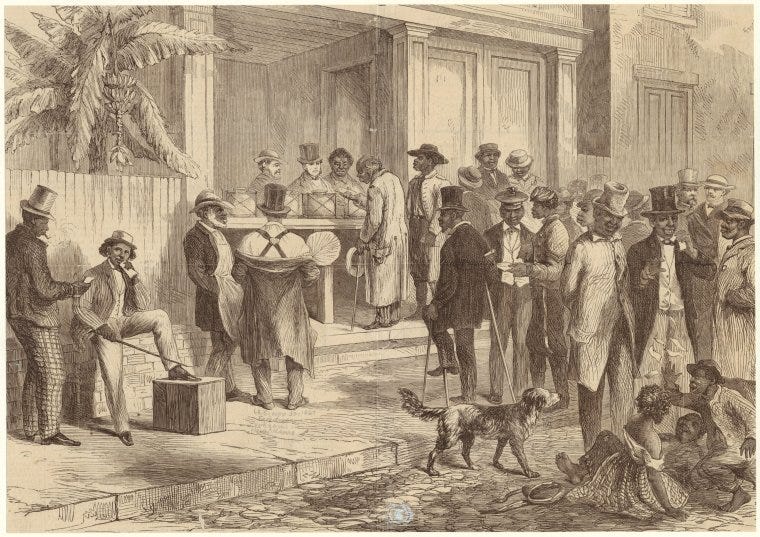
African Americans, through consistent advocacy, not only pushed for greater rights but also sought to maintain political power in the Republican Party. Through their votes, African Americans brought about Republican majorities in the South, including the election of nearly 2,000 Black representatives to state and federal legislatures.9 10 These efforts and the adoption of the Fourteenth and Fifteenth Amendments helped challenge the idea that America was a white man’s country and his country alone.
Violence and Reprisal
Fearing the end of racial hierarchy and the loss of free labor that came with slavery, white Southerners, especially former enslavers, feared and attempted to quash it through terroristic violence. In May of 1866, white mobs in Memphis, Tennessee, began burning buildings and attacking and killing black residents over an argument that broke out with Black soldiers and white police officers. The violence and the subsequent Southern press’s attempt to blame the Black soldiers appalled Northern journalists. One Republican newspaper, the Independent, described the violence in vivid detail, saying “The freedman at Memphis… have been hunted in the streets, women and children shot in cold blood, their homes burnt over their heads and at least one woman burnt alive, their churches and schools burnt to the ground…”11
By 1868, the Ku Klux Klan had formed and began attacking Black voters and Northern Republicans in the hopes of achieving its white supremacist agenda. Though they would subsequently be put down under federal legislation, other organizations continued their attacks.12
Southern legislatures, seeking to wrestle control away from Black voters and the Republican Party, instituted “Black Codes,” which ensured that former enslaved people were tied to white employers.13 Black children could be “apprenticed” to a white person at the direction of a court, and that white person had the power to inflict “such moderate corporeal chastisement as a father or guardian is allowed to inflict on his or her child or ward at common law…”14 Through legal and illegal means, White Supremacists in the South drove African Americans from the ballot box and would eventually institute Jim Crow.
Reconstruction Ends
Though Reconstruction was an impressive and powerful display of strength and a remarkable effort to ensure racial equality, it would end by the late 1870s as the previously pro-Reconstruction Republican Party gradually abandoned the project. In his 1877 inaugural address, incoming Republican President Rutherford B. Hayes promised to advocate for what he saw as the “truest interests of the white” and “colored people” to create a stronger nation. Hayes made little mention of the violence or voter suppression efforts by Southern white supremacists and instead stated his high hopes for a newly established, united country.15 Union troops were withdrawn, and with their departure, the mechanism for enforcing racial equality disappeared, and the rise of Jim Crow was secure.
This was not an accident, as an agreement was hatched between the Southern Democrats and Hayes’ Republican allies to secure the presidency. In a private meeting with a New Orleans editor carrying messages from Louisiana Democrats, Hayes remarked that he believed “the intelligence of any country ought to govern it,” suggesting his support for Southern home rule.16 With home rule came the end of Reconstruction.
Final Thoughts
While it is easy for many politicians to embrace the idea of perpetual improvement and justice, the reality is that equality and justice are not guaranteed. It does not erase the pain and sacrifices of those who gave their lives for a better America, nor does it unify the country. It only creates more wounds to open in the future.
Removing monuments to enslaved people, lynching victims, and advocates for justice is not acceptable. Refusing to talk about racism is not an act of historical preservation; they are a method of historical negligence and erasure. If we are to be a more perfect union, then the study of history, in its own context, must remain free to criticize the past and evaluate it in its own terms, irrespective of appeals to national pride, ethnonationalism, or partisanship. The people who fought and died for a better tomorrow deserve better; we deserve better.
Deena Zaru, “Trump Admin Removes Memorial Honoring People Enslaved by George Washington in Philadelphia,” News, ABC News, January 23, 2026, https://abcnews.com/US/trump-admin-removes-memorial-honoring-people-enslaved-george/story?id=129472615.
Donald Trump, “Restoring Truth and Sanity to American History,” The White House, March 27, 2025, https://www.whitehouse.gov/presidential-actions/2025/03/restoring-truth-and-sanity-to-american-history/.
Hannah Schoenbaum, “Trump Administration Ordered to Restore George Washington Slavery Exhibit It Removed in Philadelphia,” AP News, February 16, 2026, https://apnews.com/article/george-washington-slavery-exhibit-restored-trump-2a32236320f280ba3e647d900c1301b4.
President’s Advisory 1776 Commission, The 1776 Report (The White House, 2021), https://trumpwhitehouse.archives.gov/wp-content/uploads/2021/01/The-Presidents-Advisory-1776-Commission-Final-Report.pdf.
H. W. Brands, “Why Reconstruction Was Doomed to Fail,” Substack newsletter, A User’s Guide to History, October 24, 2025. Link.
Conor Kelly, “Not All History Is Made Equal,” Fall 2021, The Observer, October 12, 2021, https://uisobserver.com/top-stories/2021/10/12/not-all-history-is-made-equal/.
Eric Foner, A Short History of Reconstruction (New York: Harper Perennial Modern Classics, 2014), Pg. XV.
Rev. Henry Highland Garnet, “Speech on Racial Equality,” February 12, 1865, in K. Stephen Prince, ed., Radical Reconstruction: A Brief History with Documents (Boston: Bedford/St. Martin’s, 2016).
Shawn Alexander, ed., Reconstruction, Violence, and the Ku Klux Klan Hearings (Bedford/St. Martin’s, 2015), pg. 24.
Olivia B. Waxman, “Why the Black Politicians of Reconstruction Are Often Overlooked,” History, TIME, February 7, 2022, https://time.com/6145193/black-politicians-reconstruction/.
“A Northern Journalist Describes Racial Violence in Memphis, Tennessee,” May 1866 in K. Stephen Prince, ed., Radical Reconstruction: A Brief History with Documents (Boston: Bedford/St. Martin’s, 2016, pg. 78.
Shawn Alexander, ed., Reconstruction, Violence, and the Ku Klux Klan Hearings (Bedford/St. Martin’s, 2015), pg. 25.
Heather Cox Richardson, To Make Men Free: A History of the Republican Party (Basic Books, 2014), pg. 87.
“Laws of the State of Mississippi, 1865” in Shawn Alexander, ed., Reconstruction, Violence, and the Ku Klux Klan Hearings (Bedford/St. Martin’s, 2015), pg. 21.
“Rutherford B. Hayes: Inaugural Address, March 5th, 1877” in K. Stephen Prince, ed., Radical Reconstruction: A Brief History with Documents (Boston: Bedford/St. Martin’s, 2016, pg. 145.
Eric Foner, A Short History of Reconstruction (New York: Harper Perennial Modern Classics, 2014), pg. 242-243.