

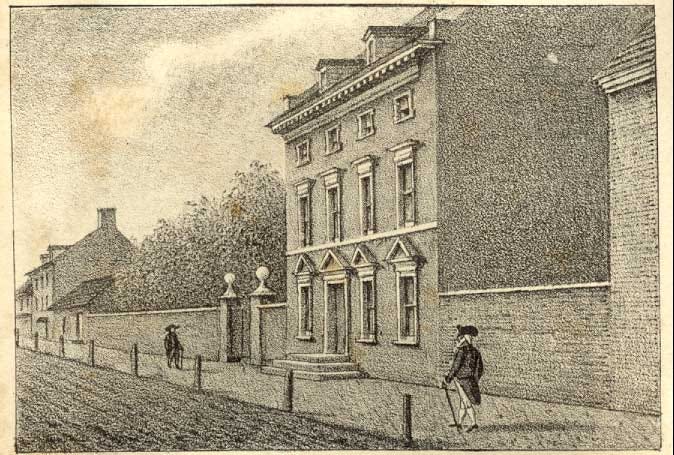
The current administration is once again putting its thumb on the scale of American history, replacing plaques on the old Presidential Home in Philadelphia.1 The plaques, which previously explored George Washington’s slave-ownership at the home, were replaced with more gentle versions that celebrated the home’s history while ignoring the people who actually lived in bondage there.
The State of Memory
On Wednesday, July 15th, an appeals court ruled that the Trump administration could proceed with removing the plaques, arguing that the federal government owns the presidential home where Washington spent much of his time as president.2 3
The removal of these plaques, which memorialized and detailed the lives of nine enslaved people under George Washington, is not only a representation of the current administration’s own political agenda but also part of a movement to disregard Black history in favor of rose-tinted mythology.
Of the nine enslaved people who were mentioned on the National Park Service’s website, three attempted to escape slavery, and two were successful. Describing one of the attempted escapees, Christopher Sheels, the NPS’ website notes: “The teenage personal attendant to George Washington. He helped the president dress and assisted with his personal needs. He attempted to escape to freedom in 1799. Later, he was present at Washington’s deathbed.”4
Nowhere in this description is Sheel’s attempt at escape described in any detail, nor are his motivations addressed. It is worth noting that Sheels was one of the enslaved people under Washington who could read and write, likely prompting fears among the Washingtons that he would use Pennsylvania law to seek his freedom. Indeed, Washington sent Sheels back permanently to Mount Vernon in 1791. 5
I am not the only one who has noticed this omission and disregard. As the historian Kevin Levin notes in his own review of the administration’s new plaques:
Even more troubling is the treatment of Ona Judge. Her panel reads, “The personal maidservant and seamstress for Martha Washington. She ran away from the President’s House and escaped to freedom in 1796. Ona settled in New Hampshire, married a freed black sailor, and had three children before passing away in 1848.”
Let’s be clear. Ona Judge did not run away from a house. She ran away from George Washington. And Washington did not simply let her go.6
The administration’s decision to describe Ona Judge in this way and with such passivity not only betrays a gross disregard for the human reality of slavery but also its historic significance. Enslaved people were and ought to be treated as actors in their own right.
Running From George Washington
Ona Judge was born at Mount Vernon in 1774 and, at the age of 10, began her service to Martha Washington. 7 Once George Washington became president, Judge went with him to the presidential mansion in Philadelphia, and would serve him until 1796, when she made her escape, boarding a ship to New Hampshire. 8 9
Despite portrayals of Washington as ambivalent and even gradually hostile to slavery, Washington never gave up his pursuit of Judge. He put out ads in the Philadelphia Gazette offering a reward of “Ten dollars… to any person who will bring her home, if taken in the city, or on board any vessel in the harbour…”10
In an 1845 interview with the abolitionist newspaper, The Liberator, Judge recounted her reasons for fleeing. Primarily, she wanted to be free, but she was also afraid of being transferred to Elizabeth Park Custis, whose temper and stubbornness were well-known. 11 12
Washington pursued her relentlessly, first sending Burwell Bassett Jr. to persuade her to return to Mount Vernon. Judge refused, telling him, “I am free now and choose to remain so.” Washington then instructed Bassett to seize her and her child by force. Judge was warned and fled to a nearby town. 13 14 15 After Washington died in 1799, Judge lived the rest of her life as a free woman along with her three children, but not because of the Washingtons’ mercy. She took her freedom.
Final Thoughts
The history of the United States is complex, multifaceted, and constantly evolving with more evidence. However, no amount of appeals to complexity or national pride can justify the disregard for the historical context of slavery and the people who were subjected to that horrible institution. As I explained in my piece on Reconstruction, these kinds of attempts to ignore slavery don’t improve the conditions of our country; they only make them more painful.
While it is easy for many politicians to embrace the idea of perpetual improvement and justice, the reality is that equality and justice are not guaranteed. It does not erase the pain and sacrifices of those who gave their lives for a better America, nor does it unify the country. It only creates more wounds to open in the future.
Removing monuments to enslaved people, lynching victims, and advocates for justice is not acceptable. Refusing to talk about racism is not an act of historical preservation; they are a method of historical negligence and erasure. 16
Recognizing the stories of enslaved people and the role founding fathers like George Washington played in their enslavement is not anti-American. Nor should it be partisan or ideological. It is a matter of good historical practice and human dignity, and the current administration is willfully obstructing that critical process.
Issac Holmberg, “Trump Administration Replaces Philadelphia Slavery Memorial,” News, Dw.Com, July 15, 2026, https://www.dw.com/en/trump-administration-replaces-philadelphia-slavery-memorial/a-77975299.
TaRhonda Thomas, “Federal Government Installs Reworked Panels about Slavery at George Washington’s Philadelphia Home,” News, 6abc Philadelphia, July 15, 2026, https://6abc.com/post/slavery-panels-replaced-presidents-house-site-philadelphia/19513565/.
Carmen Russell-Sluchansky, “National Park Service Replaces Philly’s President’s House Slavery Exhibit,” WHYY, July 15, 2026, https://whyy.org/articles/presidents-house-slavery-trump-exhibit-philadelphia-replaced/.
“Visiting the President’s House Site: From Enslavement to Emancipation - Independence National Historical Park (U.S. National Park Service),” National Park Service, July 15, 2026, https://www.nps.gov/inde/planyourvisit/presidentshousesite.htm.
Lindsay Chervinsky, “The Enslaved Household of President George Washington,” WHHA (En-US), The White House Historical Association, September 6, 2019, https://www.whitehousehistory.org/the-enslaved-household-of-president-george-washington.
Kevin M. Levin, “Ona Judge Didn’t Run Away From a House,” Substack newsletter, Civil War Memory, July 15, 2026, Substack.
Meilan Solly, “Ona Judge Escaped From Slavery While George Washington Was Busy Eating Dinner Inside. Now, a New Mural Honors Her Legacy,” Smithsonian Magazine, accessed July 15, 2026, https://www.smithsonianmag.com/smart-news/ona-judge-escaped-from-slavery-while-george-washington-was-eating-dinner-inside-now-new-mural-honors-her-legacy-180988851/.
Erica Dunbar, “Opinion | George Washington, Slave Catcher - The New York Times,” The New York Times, February 16, 2015, https://www.nytimes.com/2015/02/16/opinion/george-washington-slave-catcher.html.
Lindsay Chervinsky, “The Enslaved Household of President George Washington,” WHHA (En-US), The White House Historical Association, September 6, 2019, https://www.whitehousehistory.org/the-enslaved-household-of-president-george-washington.
Frederick Kitt, “Advertisement for the Capture of Oney Judge, Philadelphia Gazette (May 24, 1796),” in Encyclopedia Virginia (Virginia Humanities, July 15, 2026), https://encyclopediavirginia.org/primary-documents/advertisement-for-the-capture-of-oney-judge-philadelphia-gazette-may-24-1796/.
Mary V. Thompson, “Elizabeth Parke Custis (1776–1831),” Encyclopedia Virginia, n.d., accessed July 15, 2026, https://encyclopediavirginia.org/entries/custis-elizabeth-parke-1776-1831/.
Thomas Archibald and Aaron Davis, “‘Washington’s Runaway Slave,’ The Liberator (August 22, 1845),” in Encyclopedia Virginia (Virginia Humanities, December 7, 2020), https://encyclopediavirginia.org/primary-documents/washingtons-runaway-slave-the-liberator-august-22-1845/.
George Washington “George Washington to Burwell Bassett, Jr.,” August 11, 1799, Document ID: 06-04-02-0197, Founders Online, http://founders.archives.gov/documents/Washington/06-04-02-0197.
Archibald and Davis, “‘Washington’s Runaway Slave,’ The Liberator (August 22, 1845).
Solly, “Ona Judge Escaped From Slavery,” Smithsonian Magazine.