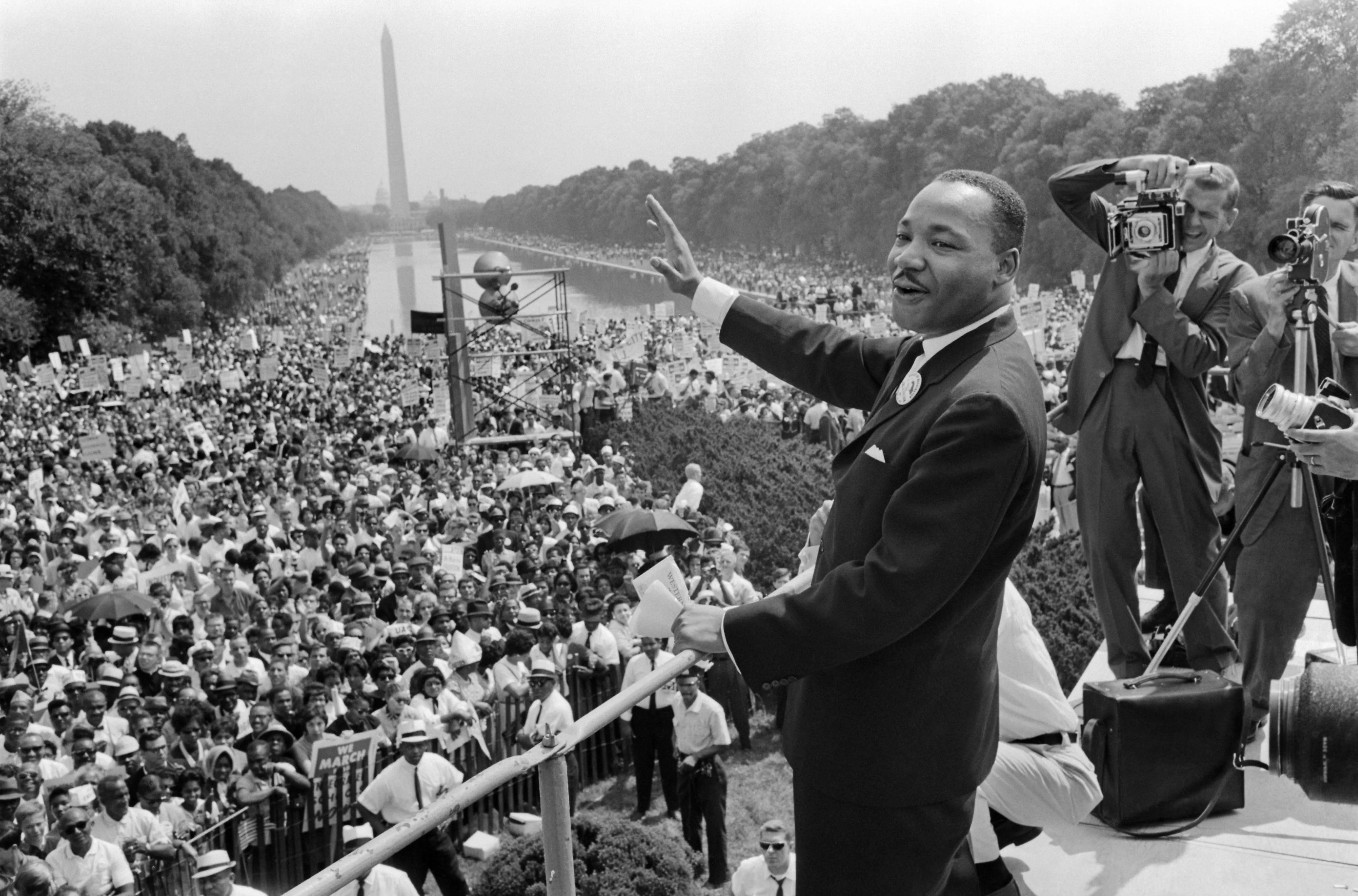
America and Martin Luther King Jr: A Vision Unrealized
This Martin Luther King Day, remember what Dr. King fought for, how his legacy was whitewashed, and the work that remains.

Today is Martin Luther King Day. For many Americans, it is a day of remembrance, and for others, a moment of respite from the toil of the workweek. However, it is sadly also a day of harmful mythologizing about the very man that it is supposed to honor. Far from giving a full view of Dr. King’s legacy, much of the discussion surrounding Martin Luther King Jr. is reductionist and whitewashes his life and struggle. For the sake of historical memory, for the man himself and for the good of the nation, America must reckon with Dr. King not as a mythologized ideal of individualism, but as the critic and radical advocate for civil rights and economic justice that he was.
Understanding Martin Luther King Jr.
At the risk of repeating myself over the years, I would like to reiterate that our understanding of historical figures, including Dr. King, is subject to change as new information and evidence are evaluated. Still, what remains constant is America’s repeated failure to appreciate Dr. King and properly understand his place in the larger American project. It is not the first time I have made this point. Previously, I warned that America has failed to appreciate Dr. King’s work and legacy fully. I have written several pieces over the years expressing dismay that America had, perhaps through willful disregard, ignored the importance of Dr. King as an actor in his own right. In my piece, A Radical Unrecognized: Dr. Martin Luther King Jr. (2021), I warned that:
“...what white America has done is sell a nicer and more complimentary activist for the American people to accept. For years, America has sold its more radical sons and daughters out for facades that cover up the incomplete nature of America’s racial and economic struggle.”
This reduction is especially pertinent now because it is in that reductionist view that our current politics fails to meet the moment of racial justice. Many point to his famous “I Have a Dream” speech to argue that Dr. King endorsed a colorblind view of race and society, allowing for a complete shutdown of discussions surrounding racial equality. They famously trot out one section of the speech, but conveniently ignore the larger picture of King’s career.
“I have a dream that my four little children will one day live in a nation where they will not be judged by the color of their skin but by the content of their character.” -Dr. Martin Luther King Jr. on August 28th, 1963.
This quote, while undeniably beautiful in its aspirations, is but one part of an entire lifetime of work. Nor is it representative of King’s overarching beliefs and activism. In her 2022 piece on this very issue, Dr. Allison Wiltz noted that this oversimplification is not only unfair and inaccurate, but it is also downright insulting to Black Americans, who are continuously forced to listen to an unending misinterpretation of King’s legacy and sacrifice. Describing this inaccurate approach to historical memory, Dr. Wiltz writes:
“His I Have a Dream speech was about how Black people were not yet free, and his dream represented an ideal of what he’d like to see, not how America actually is. Unfortunately, America is in love with a version of itself that doesn’t exist. When white people misquote King, they rob his dream of its meaning while supporting policies that maintain nightmarish conditions for Black Americans.” -Dr. Alison Wiltz, Why We’re Sick and Tired of People Misusing King’s Words, 2022.
Indeed, the colorblind King is largely a mythological phenomenon, and it puts him in a box that ignores the totality of his many critiques of America and the role of white supremacy in our society. Far from being purely an opponent of individualized prejudice, Dr. King was a firm critic of economic disparities and poverty. In the introduction to King’s Where Do We Go From Here? (2010), historian and civil rights activist Vincent Harding explained that Dr. King, throughout his work, continued to “insist that his organization and his nation focus themselves and their resources on dozens of exploited Black communities—and especially their desperate young men, whose broken lives were crying out for new, human possibilities in the midst of the wealthiest nation in the world” (Harding 2010, pg. xiii).
From the beginning, Dr. King was known, even among his contemporaries, for his systemic view of the problems that continue to impact America today. It is this systemic approach that was central to Dr. King’s views, and it is also part of the reason that much of white America rejected him.
Rejection and Hostility
Despite the valorization of his legacy today, Dr. King was vehemently despised in his time. A 1968 Harris poll found that his disapproval rating was almost 75 percent. Just two years before that, another poll showed that 63 percent of Americans viewed Martin Luther King Jr. negatively. This was, in part, due to his intense refusal to engage with violence, and more pertinently, his strong pro-union and welfare state politics. White America’s response to his politics, as King himself would describe it, was far from ideal. Explaining the white reaction to the Civil Rights Movement and the subsequent fight against poverty and exploitation, King wrote:
“white America was ready to demand that the Negro should be spared the lash of brutality and coarse degradation, but it had never been truly committed to helping him out of poverty, exploitation, or all forms of discrimination” (King, 2010, pg. 3).
Dr. King believed that the country, including the government, had a responsibility to provide and support communities in poverty. In an interview with Playboy’s Alex Haley, King publicly stated his support for a national economic aid program for Black youth, which, according to King, would cost $50 billion, and that was in 1965. Such a policy would almost certainly cost more today.
Final Thoughts
Dr. King’s vision was far more extensive than America has fully appreciated, and that vision remains unrealized. Just last year, USA Today reported that nearly a quarter of American households are living paycheck to paycheck. The percentage of Americans who can’t afford healthcare has risen to 11 percent, or 29 million people, with Black and Hispanic Americans suffering the worst. If America wants to realize Dr. King’s vision, it must tackle poverty not as an individual failure, but as a societal one that continues to perpetuate white supremacy. Anything less is insufficient.
Bibliography
60 Minutes. 1966. September 27, 1966: MLK—“A Riot Is the Language of the Unheard.” YouTube video, 4:31. Originally aired September 27, 1966. Posted September 27, 2018.
Bruyneel, Kevin. 2014. “The King’s Body: The Martin Luther King Jr. Memorial and the Politics of Collective Memory.” History and Memory 26, no. 1: 75–108. https://doi.org/10.2979/histmemo.26.1.75.
Cobb, James. 2018. “Even Though He Is Revered Today, MLK Was Widely Disliked by the American Public When He Was Killed.” Smithsonian Magazine, April 4. https://www.smithsonianmag.com/history/why-martin-luther-king-had-75-percent-disapproval-rating-year-he-died-180968664/.
Gelder, Lawrence Van. 1968. “Dismay in Nation.” New York Times, April 5.
Haley, Alex. 1965. “Playboy Interview: Martin Luther King Jr.” Playboy, January. PDF. https://neighborhoodparish.org/uploads/1/9/8/5/19859747/mlk_playboy_interview_by_alex_haley.pdf.
Hatfield, Jenn. 2023. “How Public Attitudes of Martin Luther King Jr. Have Changed since the 1960s.” Pew Research Center, August 10. https://www.pewresearch.org/short-reads/2023/08/10/how-public-attitudes-toward-martin-luther-king-jr-have-changed-since-the-1960s/.
Kelly, Conor J. 2025a. “A Radical Unrecognized: Dr. Martin Luther King Jr.” The Progressive American Report, January 29. https://www.progressiveamerican.net/p/a-radical-unrecognized-dr-martin-luther-king-jr-db0f21959b73.
Kelly, Conor J. 2025b. “America Still Doesn’t Understand Martin Luther King.” The Progressive American Report, January 29. https://www.progressiveamerican.net/p/america-still-doesnt-understand-martin-luther-king-35db264e22ff.
King, Martin Luther, Jr. 1963. “Letter from Birmingham Jail.” April 16. https://kinginstitute.stanford.edu/encyclopedia/letter-birmingham-jail.
King, Martin Luther, Jr. 2010. Where Do We Go from Here: Chaos or Community? With Vincent Harding and Coretta Scott King. Boston: Beacon Press.
Lessenberry, Jack. 2026. “Who Martin Luther King Jr. Really Was.” Politics and Prejudices and Other Musings (Substack newsletter), January 16. https://jacklessenberry.substack.com/p/who-martin-luther-king-jr-really.
Lin-Fisher, Betty. 2025. “More Americans Are Living Paycheck to Paycheck. We Explain Why.” USA Today, November 20. https://www.usatoday.com/story/money/2025/11/15/more-living-paycheck-to-paycheck-why/87201940007/.
Maese, Ellyn, and Dan Witters. 2025. “In U.S., Inability to Pay for Care, Medicine Hits New High.” Gallup, April 2. https://news.gallup.com/poll/658148/inability-pay-care-medicine-hits-new-high.aspx.
Reed, Harry A. 1999. “Martin Luther King, Jr.: History and Memory, Reflections on Dreams and Silences.” Journal of Negro History 84, no. 2: 150–66. https://doi.org/10.2307/2649044.
The Martin Luther King, Jr. Research and Education Institute. n.d. “‘Beyond Vietnam.’” Accessed January 17, 2026. https://kinginstitute.stanford.edu/encyclopedia/beyond-vietnam.
The New York Times. 1968. “President’s Plea.” April 5. https://timesmachine.nytimes.com/timesmachine/1968/04/05/90666175.html.
Wiltz, Allison. 2022. “Why We’re Sick and Tired of People Misusing King’s Words.” Momentum, January 14. https://momentum.medium.com/why-were-sick-and-tired-of-white-people-misusing-king-s-words-db1c8e34a9dc.


